


How Do BOM, OPC, and FPC Make Production Planning More Accurate in Automotive ERP?
How do BOM, OPC, and FPC make production planning in automotive ERP more accurate? Explore SidarSoft’s comprehensive solutions for precise costing, parts traceability, and production optimization in discrete manufacturing.
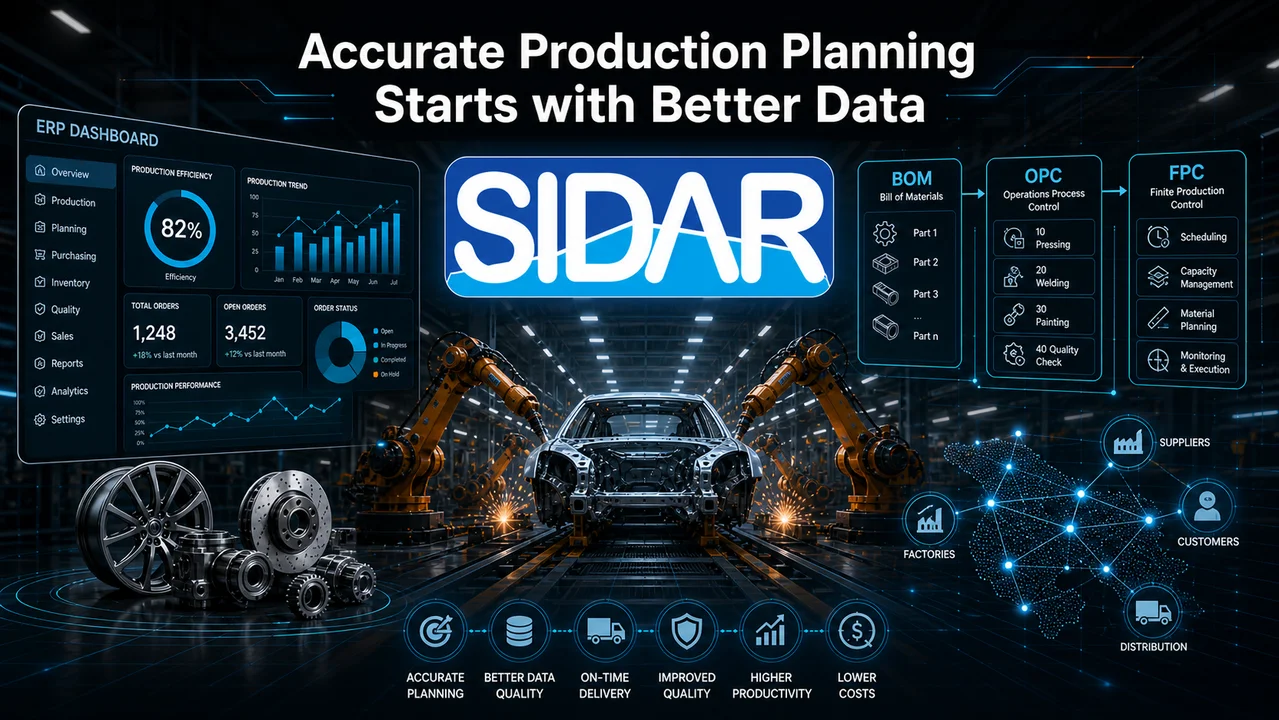
The automotive and auto parts manufacturing industry is one of the most complex and supply-chain-dependent sectors in the world. In this field, producing a vehicle or even a single component requires the coordination of thousands of parts, dozens of work stations, and precise scheduling. The slightest deviation or calculation error in the production line can lead to assembly line shutdowns, delivery delays to upstream automakers, and massive financial losses.
The main difference between a traditional workshop and a modern, smart automotive factory lies in how technical data and production processes are managed. Implementing a comprehensive automotive ERP system allows managers to shift from reactive firefighting to proactive planning. Within this framework, utilizing three fundamental tools—BOM (Bill of Materials), OPC (Operation Process Chart), and FPC (Flow Process Chart)—forms the backbone of accurate production planning.
The Key Role of BOM in Manufacturing Engineering and ERP
The product structure, or BOM (Bill of Materials), is far more than a simple list of parts; it is essentially the DNA of your product. This structure details the components, raw materials, sub-assemblies, and exact quantities required to manufacture a specific automotive assembly (such as a dashboard, suspension system, or chassis).
In a specialized ERP system like SidarSoft, the BOM is directly integrated with inventory, purchasing, and Material Requirements Planning (MRP). When a production order is issued, the system automatically explodes the BOM, checks available stock, and generates purchase or production requisitions for sub-assemblies if there are shortages. This prevents the accumulation of dead inventory while simultaneously preventing line stoppages due to missing parts.
OPC and FPC: The Operational Roadmap of the Production Line
While the BOM addresses the "material" aspect of production, OPC and FPC are the tools that manage the "process and time" dimensions:
- OPC (Operation Process Chart): Maps out the step-by-step sequence of manufacturing, assembly, testing, and inspection operations performed on a part, from raw material entry to the finished product. This chart helps engineers determine which workstation and machinery should be used for each operation.
- FPC (Flow Process Chart): Captures much more granular details, including transportation times between stations, temporary delays, inspections, and storage during the process. FPC is crucial for identifying non-value-added time and optimizing plant layout.
Synergy of BOM, OPC, and FPC in Sidar ERP
The real power is unleashed when these three tools are integrated into a single, unified database within SidarSoft's ERP software. The outcomes of this synergy include:
- Accurate Costing: With precise material consumption (BOM) and standard operation times (OPC), the actual cost of goods manufactured (COGM) is calculated with maximum precision and minimal variance.
- Advanced Capacity Planning: The system recognizes the capacity of each workstation and schedules production based on available work shifts and machinery.
- Full Traceability: In the automotive industry, tracking which raw material (with which batch number) was used in which specific vehicle component is vital. Sidar ERP enables seamless traceability from suppliers to the final product.
Are you looking to elevate your management and smarten your auto parts factory?
To learn more about our solutions, modules, and software features designed specifically for the automotive industry, please visit our dedicated page:



Frequently Asked Questions
How Do BOM, OPC, and FPC Make Production Planning More Accurate in Automotive ERP?The automotive and auto parts manufacturing industry is one of the most complex and supply-chain-dependent sectors in the world. In this field, producing a vehicle or even a single component requires the coordination of thousands of parts, dozens of work stations, and precise scheduling. The slightest deviation or calculation error in the production line can lead to assembly line shutdowns, delivery delays to upstream automakers, and massive financial losses.</p> <p>The main difference between a traditional workshop and a modern, smart automotive factory lies in how technical data and production processes are managed. Implementing a comprehensive <strong>automotive ERP</strong> system allows managers to shift from reactive firefighting to proactive planning. Within this framework, utilizing three fundamental tools—<strong>BOM (Bill of Materials)</strong>, <strong>OPC (Operation Process Chart)</strong>, and <strong>FPC (Flow Process Chart)</strong>—forms the backbone of accurate production planning.</p> <h3>The Key Role of BOM in Manufacturing Engineering and ERP</h3> <p>The product structure, or <strong>BOM (Bill of Materials)</strong>, is far more than a simple list of parts; it is essentially the DNA of your product. This structure details the components, raw materials, sub-assemblies, and exact quantities required to manufacture a specific automotive assembly (such as a dashbo
An accurate BOM allows the ERP system to calculate the exact quantities of raw materials needed. This prevents over-purchasing or material shortages during production, minimizing waste and directly lowering the product’s cost of goods sold.
What is the main difference between OPC and FPC, and when is each used?
The OPC focuses on the sequence of manufacturing operations (e.g., turning, welding) to map out key fabrication steps. The FPC provides deeper details, including transport times and delays between stations, which is critical for optimizing workflow on the shop floor.
How does Sidar ERP integrate these tools with the financial module?
Sidar ERP connects all BOM and OPC data to the cost accounting and financial systems. As soon as actual production is recorded at a workstation, material consumption and direct labor costs are automatically calculated and updated in the financial ledgers.
Is using these tools in an ERP helpful for small auto parts workshops?
Yes. Even in small-scale operations, properly defining the product structure (BOM) and routing (OPC) helps managers accurately calculate the profitability of each part and identify which products generate the best margins.
How does FPC integration in the production system help reduce bottlenecks?
Using the FPC, production managers can monitor unnecessary waiting times between workstations. By analyzing this data in Sidar ERP, they can adjust the assembly line layout or shift schedules to eliminate bottlenecks.