


Vehicle Allocation and Delivery Order Management from Automaker to Dealership via DMS
Guide to vehicle allocation and delivery orders via Sidarsoft DMS; smart VIN allocation, barcode orders and transparent delivery.
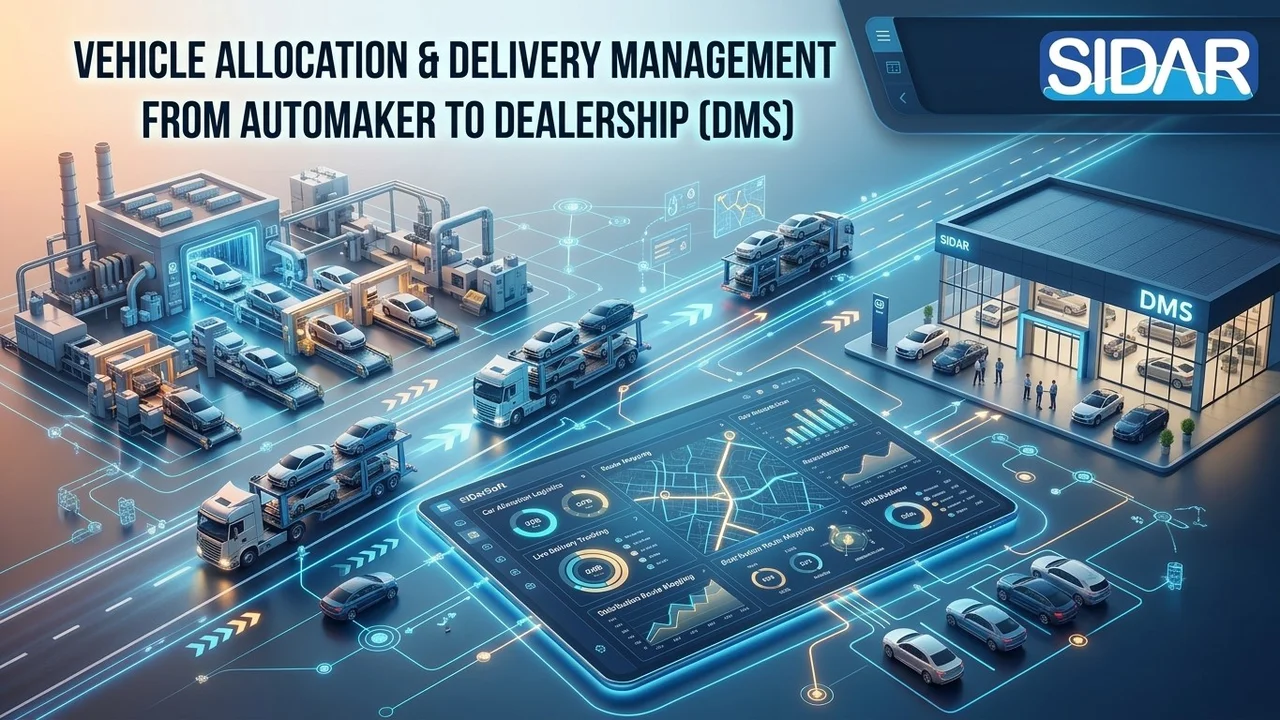
Vehicle Allocation and Delivery Order Management from Automaker to Dealership (DMS); The Most Comprehensive Guide in Sidarsoft ERP
1. Why Allocation and Delivery Order Are the Most Important Bottleneck in Vehicle Distribution
In the automotive industry, production is only half of the value creation journey. The second and decisive half is delivering the right vehicle to the right dealership, at the right time, and for the right customer. Experience of automakers, importers and assemblers shows that more than 60% of customer dissatisfaction and friction between headquarters and the network comes not from product quality but from delays in allocation, ambiguity in delivery orders, mismatched trim and color delivery, and lack of financial transparency.
In the traditional model based on Excel, phone calls, letters and in-person follow-ups, the allocation queue is non-transparent, vehicles accumulate in central parking, capital remains idle, accounts of automaker and dealerships diverge, and finally late-delivery penalties and brand damage occur. The Dealer Management System (DMS) within Sidarsoft Comprehensive Automotive ERP is designed to automate this exact bottleneck, so that no step from sales plan definition to final delivery is performed outside the system, without documentation or without a responsible owner.
Sidarsoft, as a specialized ERP provider for the automotive industry, manages the chain from production and supply to sales, warehousing and after-sales service in one smart integrated platform. Its Vehicle Sales module covers zero-to-hundred sales from lead and pre-contract to contract, allocation, kardex, delivery and management reports, usable for automakers, importers, assemblers and dealership networks in multi-brand and multi-dealership format.
2. Basic Concepts: Order, Quota, Allocation, Delivery Order, Kardex and Receipt
In Sidarsoft ERP each of these concepts is an independent entity with separate workflow, document and owner:
| Concept | Precise Definition | Owner | System Document |
|---|---|---|---|
| Dealership Order | Official request to purchase specific number of vehicles with trim, color and sales plan | Dealership in DMS panel | Dealership sales order |
| Quota | Allowed allocation ceiling per dealership monthly or per plan | Automaker sales HQ | Quota and scoring table |
| Allocation | Firm reservation of a physical unit with specific VIN for a contract | Allocation engine | Allocation doc + kardex lock |
| Delivery Order | Official permit for vehicle exit from central warehouse to carrier | Central warehouse + Finance | Barcoded warehouse order |
| Kardex | Unique file of each VIN from production to final delivery | System automatically | Cloud kardex |
| Receipt | Confirmation of physical entry to dealership | Dealership warehouse | Dealership warehouse receipt |
3. Position of DMS in Sidarsoft Comprehensive ERP Architecture
The key differentiation of Sidarsoft is its integrated view. DMS is not an isolated software on the dealership desk; it is part of a unified ERP connecting automaker HQ, central warehouse, finance and treasury, logistics, after-sales service and all dealerships in one logical data model. When a dealership registers an order, central warehouse stock, dealership ledger, cheques in process, customer contract and production queue are simultaneously visible at HQ.
- Integration with Vehicle Sales: Order linked to contract, proforma, sales plan, daily trim and color price, addendum, invoice and accounting voucher.
- Integration with Finance and Treasury: Credit limit, debt balance, post-dated cheques, guarantees and high-ceiling payment gateway control.
- Integration with Inventory and VIN: Tracking vehicle inventory by trim, color and chassis in branches, warehouses and dealerships with transfer, reservation and allocation.
- Integration with Logistics: Definition of carriers, drivers, waybills and transport tracking to receipt.
- Integration with CRM and Customer Panel: Lead registration, follow-up, online document upload, sales process tracking and automatic notification.
- Integration with After-Sales Service: Warranty start from system delivery date and linking chassis history to warranty file.
4. Complete 10-Step Allocation and Delivery Order Cycle in Sidarsoft
Step 1: Sales Plan and Circular Definition
The parent company sales management defines cash sales, instant sales, ordinary and participatory pre-sales, installment, leasing, bank facilities, organizational and exhibition plans. For each plan, trim, allowed colors, approved price, down payment, number and amount of installments, participation profit, delay penalty, delivery date and customer eligibility are defined and systematically notified to the whole network.
Step 2: Dealership Quota Setting
Each dealership quota is set based on rank, average sales, customer satisfaction, overdue receivables and document discipline. The system does not allow orders exceeding quota except with senior management override with reason and log.
Step 3: Order and Contract Registration at Dealership
The sales expert in the web DMS panel sees remaining capacity, registers the contract with identity verification, duplicate national code control, down payment collection and document upload. Incomplete contracts do not enter the allocation queue.
Step 4: Two-Layer Financial Validation
First layer is dealership credit including ledger balance, bounced cheques and guarantees, second layer is customer settlement including payments, approved leasing facilities and cheques. Incomplete files remain in Awaiting Finance status with automatic alert.
Step 5: Entering Allocation Queue
Financially approved contracts are sorted in queue based on contract age, proximity of delivery date, plan type and dealership score. This queue is fully transparent and auditable for HQ.
Step 6: Allocation Execution and VIN Lock
Commercialized inventory with quality release is assigned to the queue. With each allocation, one VIN is locked to one contract, deducted from free inventory and recorded in kardex, with no possibility of re-allocation.
Step 7: Automaker Invoice to Dealership
Invoice is issued with daily approved price, VAT and tolls, and accounting voucher is automatically posted to dealership ledger. In case of price change, price-difference addendum is proposed.
Step 8: Barcoded Warehouse Delivery Order
Delivery order is issued with VIN, engine number, trim, color, parking location, destination and carrier. Its output is a unique barcode as basis for exit-gate control.
Step 9: Loading, Transport and Tracking
After barcode matching and body photo registration, vehicle is loaded onto carrier. Waybill number, driver details and ETA are recorded and status changes to In Transit.
Step 10: Dealership Receipt and Delivery Preparation
Dealership storekeeper matches physical VIN and registers receipt. Transport discrepancy is documented with photos and referred to HQ. Dealership stock increases and vehicle enters PDI, plating and handover with minutes.
5. Quota Setting and Sales Policy
Fair quota is precondition for fair allocation. In Sidarsoft fixed, floating, incentive and limited quota models for high-demand plans can be combined. Quota consumption is calculated automatically and remaining capacity is displayed. Excess requests require multi-level approval and are reflected in audit reports.
6. Smart VIN Allocation; Justice Engine
The allocation engine observes three principles simultaneously: priority of older contract, priority of overdue commitments, and financial health. Manual allocation outside queue is allowed only with special role, written reason and complete log. The result removes rent suspicion and increases network trust.
7. Financial and Legal Controls Before Delivery Order
- Control of dealership ledger balance and approved credit ceiling
- Control of cheques, due dates and bounced history
- Control of customer settlement, leasing and bank facilities
- Control of daily trim and color price and addendum issuance
- Control of duplicate national code, registration limits and circular conditions
- Official invoice issuance and automatic accounting voucher
8. Warehouse Delivery Order, Barcode and Loading Control
The delivery order is the connection point of sales and warehouse. Each VIN has a specific parking location, and without barcode scan the exit gate does not allow loading. Matching chassis, engine number and color with body photo documentation reduces wrong delivery error to almost zero.
9. Logistics, Waybill and Carrier Tracking
The logistics module maintains carrier companies, carrier capacities, route rates and delay history. Each delivery order is linked to one waybill and delay is recorded in contractor KPI. The dealership sees ETA and customer receives SMS Your vehicle is on the way to the dealership.
10. Dealership Receipt, Discrepancy Control, PDI
Until receipt is registered, dealership stock does not increase and delivery to customer is not allowed. This rule prevents selling a vehicle on the road. After receipt, vehicle enters technical inspection, option installation, carwash, plating and handover minutes preparation.
11. Cloud Kardex; Digital Identity of VIN
Sales kardex is the lifetime file of each unit: production date, end-of-line test, quality blocks, parking entry, allocation, contract and customer, invoice, delivery order, waybill, receipt, PDI and final delivery. This identity prevents re-selling one chassis, document forgery and warranty disputes.
12. Integration with Finance, Treasury and Leasing
The sales module supports cash, installment, leasing and facility sales. Installment schedule is generated based on down payment and profit rate, due dates are SMS-reminded and each installment is posted to customer ledger. Cheques, promissory notes and guarantees are managed with in-safe, in-collection, collected or bounced status.
13. CRM, Customer Panel and Automatic Notification
For each event a message template is defined: queue entry, chassis allocation, delivery order issuance, loading and ready for delivery. The customer via dedicated panel uploads documents online, sees payments and tracks delivery status. This transparency drastically reduces follow-up calls.
14. Traditional Distribution Challenges and Sidarsoft Solutions
| Challenge | Hidden Cost | Solution in Sidar DMS |
|---|---|---|
| Manual allocation with Excel | Rent and complaints | Smart parametric queue with full log |
| Incomplete contract | Delivery delay | Document checklist and auto block |
| Delinquent dealership | Receivables accumulation | Auto allocation stop until settlement |
| Sedimentation in central parking | Idle capital | Sediment alert and no-order dashboard |
| Wrong trim and color delivery | Return transport | VIN lock + barcode control |
| HQ-dealership account mismatch | Long dispute | Integrated ledger and auto reconciliation |
| Customer unawareness | Satisfaction drop | Online tracking and auto SMS |
| Undocumented transport damage | Insurance dispute | Photo registration at loading and receipt |
15. Reports, Dashboards and KPI Indicators
- On-Time Delivery OTD: Most important satisfaction and commitment index.
- Allocated vehicles without order: Financial sediment index.
- Transport performance: Delay and damage of each contractor.
- Dealership ranking: Combination of sales, good accounting and satisfaction.
- Trim and color analysis: Basis for production plan and quota.
16. Standardizing Dealership Network with Integrated DMS
When all dealerships work with one process, one checklist, one financial rule and one delivery SLA, customer experience becomes identical nationwide. New sales circular is notified and executed to whole network in one day. This agility in volatile auto market is a decisive competitive advantage.
17. Strategic Summary and Implementation Roadmap
Allocation and delivery order is the showcase of distributive justice, financial health and brand credibility. Sidarsoft ERP with coverage from lead registration to delivery removes hidden operational cost, reduces capital idle time and maximizes network and customer satisfaction. Roadmap includes circular standardization, VIN kardex launch, DMS panel connection and training, and activation of dashboard and smart allocation engine.
Sidarsoft; Comprehensive Automotive ERP for Automakers, Importers and Dealership Networks


Frequently Asked Questions
Exactly when is vehicle allocation done in DMS?
After final contract registration, document completion, down payment collection per circular, and dealership credit approval. At this moment a specific VIN is locked to the contract, deducted from free inventory and cannot be re-allocated.
What is the difference between delivery order and allocation and why are both needed?
Allocation is reserving a specific vehicle for a specific customer, and delivery order is the official permit for exit of that vehicle from central warehouse. Delivery order is issued only for allocated VIN and after invoice and settlement; without delivery order loading is not allowed.
If dealership has overdue debt, is new allocation done?
No. Credit ceiling, ledger, cheques and guarantees are controlled online, and until settlement or HQ authorization, new allocation remains automatically blocked to manage automaker financial risk.
How is wrong color and chassis delivery prevented?
Through three layers: VIN lock to contract in kardex, barcoded delivery order for same VIN, and barcode matching with physical chassis at loading and receipt. In case of any mismatch exit is denied.
How does the end customer know vehicle status?
Through customer panel and web application with tracking code; contract, allocation, delivery order, transport and ready-for-delivery stages are visible in real-time with automatic SMS notification without phone follow-up.