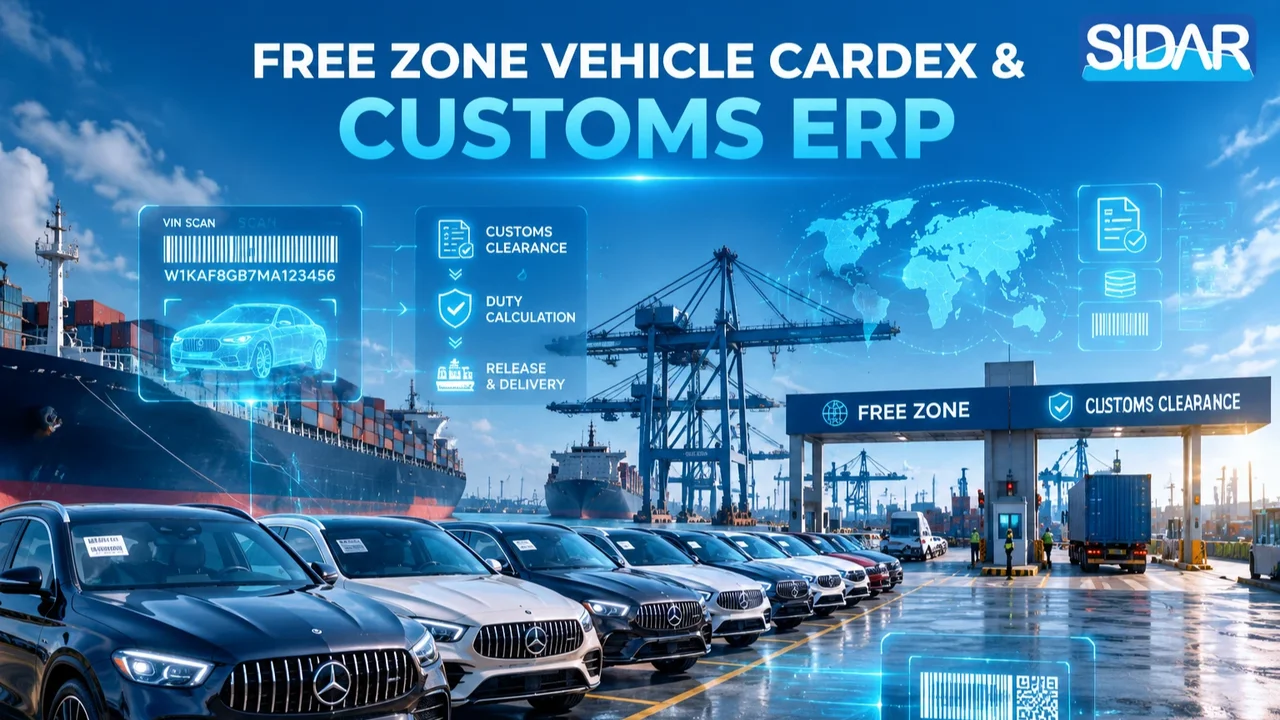
Integrating Vehicle Cardex with Customs & Clearance in Free Zones: From Ship Arrival to Final Delivery via ERP
In the automotive import and distribution sector within Free Zones and commercial ports, a "Vehicle Cardex" (Vehicle Registry) is far more than a simple document or spreadsheet—it is the living operational identity of a vehicle. This registry must meticulously document every stage of a vehicle's journey: from the moment the carrier vessel docks, through customs inspection and valuation, technical testing, depot storage management, and landed cost allocation, all the way to final plate registration and handover to the customer. The primary failure point occurs when these data points are managed through scattered Excel files and manual logs disconnected from clearance documentation. The sustainable institutional solution is full integration between the Vehicle Cardex and customs clearance processes within an ERP environment, establishing a single source of truth that ensures operational precision, speed, and strict compliance.
The Isolation Crisis: Why Traditional Clearance Methods Fail
The Free Zone operational environment is characterized by regulatory complexity and extreme time sensitivity. Relying on disconnected platforms—customs data held by brokers, warehouse logs in manual notebooks, and accounting cost calculations handled in isolation—leads to costly operational gaps:
- VIN and Technical Mismatches: A single typographical error in a Vehicle Identification Number (VIN), engine number, or technical spec between the customs declaration and the vehicle registry can freeze a transaction, delaying registration for weeks or even months.
- Commercial and Delivery Conflicts: Lack of real-time synchronization between customs status and sales management often leads to selling vehicles that are still tied up in inspection lanes or pending regulatory compliance reports, resulting in legal liabilities and heavy delay penalties.
- Opaque Landed Cost: Port fees, handling charges, insurance, entry fees, and demurrage penalties are often delayed, preventing accurate cost allocation per chassis. This distorts pricing decisions and profit margins.
- Frozen Working Capital: Long dwell times for vehicles in port yards due to sluggish paper-based document cycles lead to the accumulation of storage fees and the stagnation of invested capital.
SidarSoft’s specialized ERP system provides the fundamental solution to these challenges by making the Vehicle Cardex the central hub for all logistics, customs, inventory, and financial movements.
What Does a Vehicle Cardex Include in the SidarSoft ERP Environment?
In SidarSoft's ERP, the Vehicle Cardex evolves from a static record into a "Comprehensive Digital Operational File" containing vital data:
- Identification & Technical Specs: VIN, Engine Number, Year of Manufacture, Brand, Model, Trim, Color, Country of Origin, and drivetrain details.
- Import & Shipping Docs: Bill of Lading (BL) number, Packing List, Proforma Invoice, and Shipping Manifest.
- Customs Path & Official Data: Customs Declaration number (Kotaj), registration date, inspection lane status (Green/Yellow/Red), and receipt numbers for paid duties.
- Compliance & Inspections: Certificates of Conformity (CoC), environmental and safety inspection reports, and pre-delivery inspection (PDI) logs.
- Depot Storage Location: Precise mapping of the vehicle's location within Free Zone storage yards (Yard ID, Lane, and Slot).
- Financial Portfolio & Costing: Tracking of all direct and indirect expenses allocated to each specific chassis, culminating in the final Landed Cost.
- Audit Trail: A digital record of all transactions, movements, and data edits, timestamped with user credentials for full accountability.
Operational Workflow: Integrating Cardex with Customs & Clearance
1. Creating the Preliminary Cardex Before Cargo Arrival
The vehicle management cycle begins before the carrier ship reaches the commercial port. As soon as shipping data is provided by the foreign supplier:
- The system generates a preliminary Cardex for each chassis based on the digital packing list.
- Reference numbers are anchored, and chassis are linked to specific Purchase Orders and supply contracts.
- Upon offloading at the port, reception staff use handheld devices to scan the chassis barcode, matching physical reality with pre-loaded data and instantly recording any visible damage or notes.
2. Direct Integration with Customs Declarations and Valuation
When a customs transaction is initiated in the Free Zone, the system automatically reflects updates in the Vehicle Cardex:
- Linking declaration numbers and Kotaj details to the specific chassis included in the transaction.
- Monitoring the designated inspection lane and documenting the physical examination stages.
- Archiving digital copies of valuation reports and duty receipts within the chassis's digital file to prevent the loss of paper assets.
3. Managing Technical Approvals and Regulatory Bodies
Vehicle imports in Free Zones are subject to technical standards and safety compliance:
- The system includes an interactive checklist of required approvals for each model.
- Updating technical compliance status and linking laboratory or environmental inspection reports to the vehicle file.
- Programming the system to restrict a chassis from moving to the next commercial stage until all mandatory digital signatures and approvals are secured.
4. Final Clearance and Gate Pass Management
Upon payment of duties and issuance of release permits or customs clearane:
- The Vehicle Cardex status automatically changes to "Customs Cleared."
- An electronic gate pass is issued, integrated with yard security and gate management systems.
- Automated gates and security barriers are programmed to allow passage only after the Cardex is scanned and the release permit is validated.
5. Precise Landed Cost Allocation
The accounting engine in SidarSoft ERP is the cornerstone for importers and traders:
- Recording all invoices for port services, clearance fees, storage, transport, and administrative charges.
- Automated distribution of shared costs across the shipment's chassis based on approved criteria (by quantity, value, or weight/volume).
- Calculating the exact final landed cost within each vehicle's Cardex, providing the sales team with the actual basis for pricing and profit margins.
6. Registration Readiness and Sales Handover
Once financial and customs aspects are closed, the Vehicle Cardex becomes authorized for Free Zone Traffic Department (Registration) procedures. Due to the high accuracy of the pre-verified data, license plate issuance and chassis inspections are completed without delays, and the system seamlessly proceeds to issue sales documents or transfer the vehicle to the customer or showroom.
Comparison: Traditional Management vs. SidarSoft ERP Cardex
| Comparison Factor | Traditional Method (Paper & Excel) | SidarSoft ERP System |
|---|---|---|
| Chassis VIN Matching | Manual, error-prone, risk of typos | Early VIN anchoring & barcode scan verification |
| Tracking Clearance Status | Constant calls to brokers, lost time | Real-time dashboard showing vehicle status |
| Import Cost Calculation | Rough estimates, delayed accounting | Precise, automated allocation of all fees |
| Yard Security | Paper permits, prone to forgery/neglect | Automated link between Cardex and gate systems |
| Customer Delivery Speed | Lengthy procedures, document review delays | Rapid delivery due to complete digital records |
Key Performance Indicators (KPIs) Post-Integration
Implementing the system allows senior management and supply chain officials to monitor precise KPIs to boost efficiency and reduce costs:
- Average Clearance Cycle Time: Measuring the duration from vessel arrival to final release.
- Demurrage Reduction Rate: Monitoring the financial decrease in port storage and detention fees.
- Data Accuracy Rate: Achieving 100% matching of chassis numbers and specs without retroactive adjustments.
- Inventory Turnover in Yards: Measuring the speed of vehicle movement from storage to delivery or showroom.