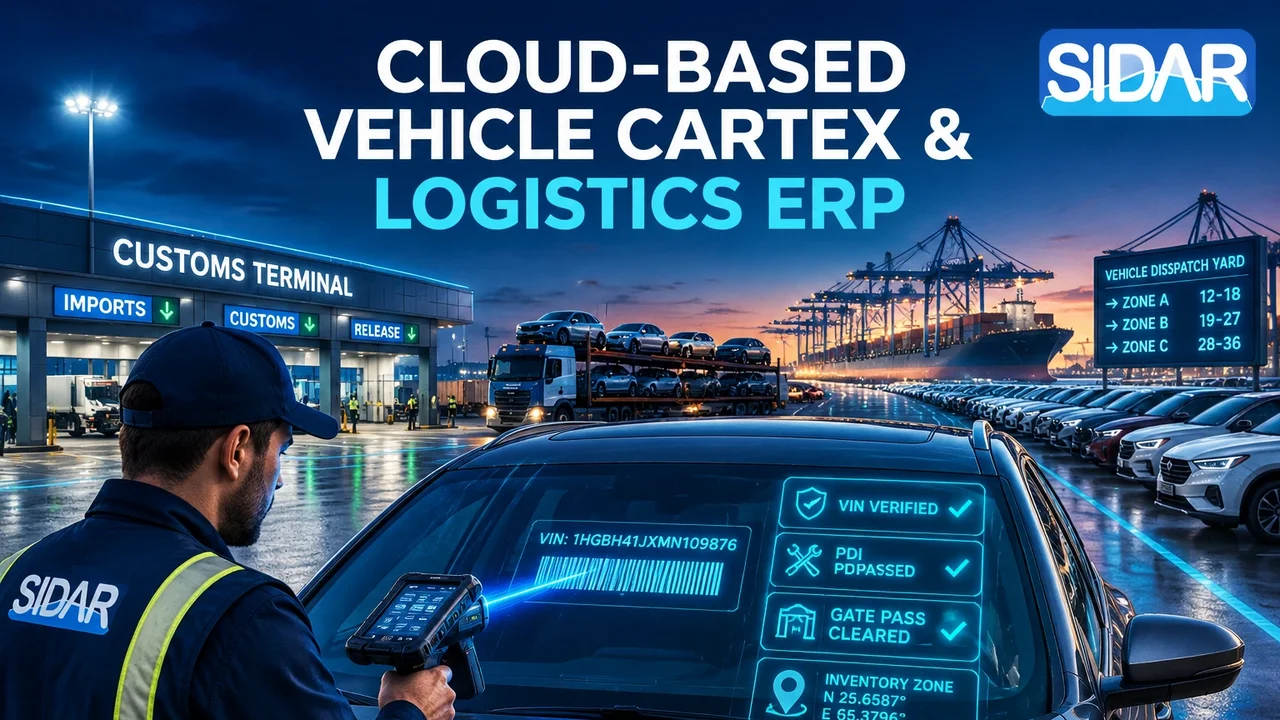
Cloud-Based Automotive Vehicle Cartex (Vehicle Master File) with Sidar ERP: The Definitive Pillar Guide to Chassis Automation, Bonded Yards, and Dealership Supply Chains
1. The Strategic Breakdown: Core Vulnerabilities of Legacy Vehicle Cartex Management
Across automotive manufacturing plants, CKD/SKD assembly lines, multi-brand importers, free-zone trading hubs, and commercial fleet distributors, the Vehicle Cartex (Vehicle Master Identity Record) is far more than a routine dispatch slip or a registration document. It serves as the legal, financial, and logistical epicenter of an individual chassis—governing its entire trajectory from customs discharge at port berths to customer handover at retail showrooms.
Despite the high financial stakes involved, numerous enterprises continue to manage these mission-critical workflows through fragmented spreadsheets, legacy desktop software, disconnected databases, and paper handover manifests. This operational disconnect introduces acute enterprise vulnerabilities:
- Catastrophic VIN Transcription Errors: Manual data entry inevitably yields typographical errors in alphanumeric strings (such as confusing '0' with 'O', '8' with 'B', or '1' with 'I'). Even a single incorrect character in customs declarations or cartex records causes vehicle impoundment at highway traffic departments, mismatched vehicle title deeds, and substantial legal penalties.
- Double Allocation Anomalies: In multi-tier dealership networks and high-volume sales setups, desynchronized inventory records often result in the exact same chassis number being allocated, invoiced, or promised to two separate corporate or retail buyers simultaneously.
- Treasury-Yard Synchronization Blindspots: Gatekeepers at logistics yards frequently release vehicles based on unverified paperwork or pending financial clearances, creating severe corporate credit exposure and unreconciled banking discrepancies.
- Runaway Port Demurrage & Yard Deterioration: Without automated yard stay aging timers and milestone alerts, imported vehicles sit unmonitored in customs terminals. This triggers compounding demurrage fees, prolonged dwell costs, and physical asset degradation—such as depleted high-voltage or 12V batteries, paint fading, and weathering.
2. Architecture of the Sidar Cloud Cartex Engine
The Sidar Cloud Cartex Engine is built directly into SidarSoft's enterprise multi-tenant cloud infrastructure and progressive web application (PWA) framework. It abstracts each physical chassis into an immutable, multidimensional digital twin that continuously updates throughout enterprise operations.
Rather than a static document, the Sidar Cloud Cartex operates across five fully synchronized enterprise tiers:
- Technical Identification Layer: Automated 17-character VIN verification, engine block serials, transmission codes, homologation specs, trim packages, factory paint codes, interior finishes, and OEM option matrices.
- Customs & Transit Layer: Seamless ingestion of bill of lading (B/L) numbers, sea-freight manifests, customs declaration manifests (Cottage numbers), clearance release orders, port berth tracking, and licensed carrier logbooks.
- Yard & Warehouse Logistics Layer: Pinpoint 3D yard positioning (terminal ID, zone, aisle, row, and exact bay coordinates) accompanied by a timestamped custody transfer logbook.
- Commercial & Fiscal Layer: Integrated pro-forma matching, unique customer tax IDs, contract models (cash, milestone financing, or operational leasing), banking reconciliation checkpoints, and VAT allocation.
- PDI & Delivery Layer: Digital Pre-Delivery Inspection (PDI) checklists, high-resolution damage photo capture, accessory inclusion logs, and cryptographic delivery handover protocols.
3. Comparative Matrix: Traditional Methods vs. Sidar Cloud Cartex ERP
The matrix below highlights the systemic performance enhancements achieved by migrating from legacy workflows to SidarSoft's automated cloud framework:
| Operational Dimension | Legacy Frameworks (Spreadsheets / Siloed Systems) | SidarSoft Cloud Cartex ERP |
|---|---|---|
| VIN Verification & Integrity | Manual operator typing; frequent character confusion and duplicate VIN registrations. | Automated ISO 3779 checksum calculation, optical barcode scanning, and hardware-level deduplication. |
| Multi-Branch Inventory Sync | End-of-day file exchanges via email; fragmented visibility across regional branches. | Real-time centralized cloud state with dynamic branch quotas, preventing parallel sales. |
| Financial Gatekeeping | Paper-based clearance slips vulnerable to accounting oversights or deferred cheque defaults. | Strict system interlocking; dispatch documents cannot be printed until automated treasury clearance is confirmed. |
| Yard Tracking & Asset Staging | Manual foot searches in expansive container yards; high time lost locating vehicles. | Sub-meter yard coordinate mapping (Zone/Aisle/Bay) with handheld barcode & QR scanning. |
| Platform Availability & Edge Access | Bound to on-premise local servers, dedicated desktop terminals, and cumbersome VPN configurations. | High-availability cloud backbone, ultra-low bandwidth consumption, and responsive mobile PWA deployment. |
| Audit Trail & Regulatory Compliance | Unverifiable record modifications; high vulnerability during tax or legal investigations. | Immutable audit trails capturing user ID, millisecond-accurate timestamps, network IP, and field-level delta changes. |
4. End-to-End Operational Lifecycle in the Sidar Cloud Cartex Ecosystem
The operational progression of every chassis inside SidarSoft ERP is managed through an orchestrated six-stage pipeline:
Stage 1: Production Discharge or Port Ingestion
Vehicles rolling off assembly lines or clearing maritime customs are ingested en masse via digital manifest imports (EDI/API) or through handheld barcode scanning by yard operators. A unique digital cartex is instantiated instantly with an initial status of "In Yard – Pending Inspection."
Stage 2: Digital Pre-Delivery Inspection (PDI)
Quality control technicians execute structured digital PDI evaluations on rugged mobile tablets. Any surface scratches, mechanical warnings, or transit damages are photographed directly into the vehicle's cloud record, categorizing the chassis as either "Certified Grade-A" or "Held for Rework."
Stage 3: Algorithmic Allocation Engine
Sidar's automated allocation engine pairs incoming inventory with qualified sales orders based on predetermined company rules—such as payment completion timestamp, contract priority, or dealership allocations. The moment a VIN is bound to an order, the system locks it against external views, eliminating double allocation.
Stage 4: Automated Fiscal & Treasury Clearance
The financial management module validates transaction compliance against bank feeds, verified down payments, and credit facility approvals. Once all ledger obligations are satisfied, the system issues an automated "Fiscal Release Token," unlocking the generation of official handover documentation.
Stage 5: Inter-Branch Logistics & Secure Dispatch
Car carrier transport waybills are generated with assigned driver credentials and licensed carrier manifests. As vehicles are loaded and unloaded across transit hubs, regional branches confirm real-time chain-of-custody by scanning vehicle QR codes upon delivery.
Stage 6: Customer Handover & Real-Time Warranty Activation
Upon final customer vehicle handover, the handover protocol is completed via SMS OTP verification and digital signature. The chassis record status shifts to "Delivered," which automatically provisions the digital warranty file, service maintenance schedules, and after-sales records in Sidar ERP.
5. Strategic ROI Across Organizational Stakeholders
For Executive Leadership & Boards of Directors:
- Holistic Working Capital Visibility: Real-time valuation of floating inventory across ports, customs storage, logistics compounds, and dealership showrooms.
- Elimination of Litigation Risk: Zero tolerance for incorrect specification handovers, title disputes, and false delivery delays.
- Frictionless Network Scalability: Onboard new regional branches or franchised dealerships within minutes without deploying local servers.
For Corporate Finance & Treasury:
- Automated Landed Cost Capitalization: Freight, tariff adjustments, customs duties, insurance, and demurrage are dynamically distributed across individual chassis records to establish accurate gross margins.
- Zero Credit Leakage: Strict system safeguards eliminate manual circumvention, ensuring that vehicles leave yards only upon confirmed receipt of funds.
For Logistics & Yard Operations:
- Instant Physical Cycle Counts: Yard-wide physical inventory counts completed in a fraction of traditional time via mobile scanning.
- Reduced Carrier Turnaround Times: Streamlined loading processes that slash carrier idle time and reduce demurrage costs.
6. Enterprise Security and Data Integrity Standards
Given the legal value and financial sensitivity of automotive distribution records, SidarSoft enforces enterprise-grade security protocols:
- End-to-End Encryption: All transactions and telemetry payloads are secured using TLS 1.3 in transit and AES-256 at rest.
- Granular Role-Based Access Control (RBAC): Yard teams are restricted to bay allocations and visual tags, inspection technicians to PDI checklists, and commercial teams to order allocations, preventing unauthorized modifications of VINs or financial entries.
- Geo-Redundant Backup Systems: Continuous data snapshots distributed across multi-region datacenters protect against catastrophic failures and guarantee operational continuity.
7. Conclusion: Driving Automotive Excellence with SidarSoft
Vehicle cartex management is no longer a clerical record-keeping duty; it is the core engine connecting supply chains, customs regulations, corporate finance, and commercial distribution. By deploying SidarSoft Cloud ERP, automotive enterprises establish full operational visibility, safeguard working capital, and build a modernized vehicle delivery ecosystem.